
Understanding Child Development: From Genes to Environment — A Complete Guide for Modern Parents
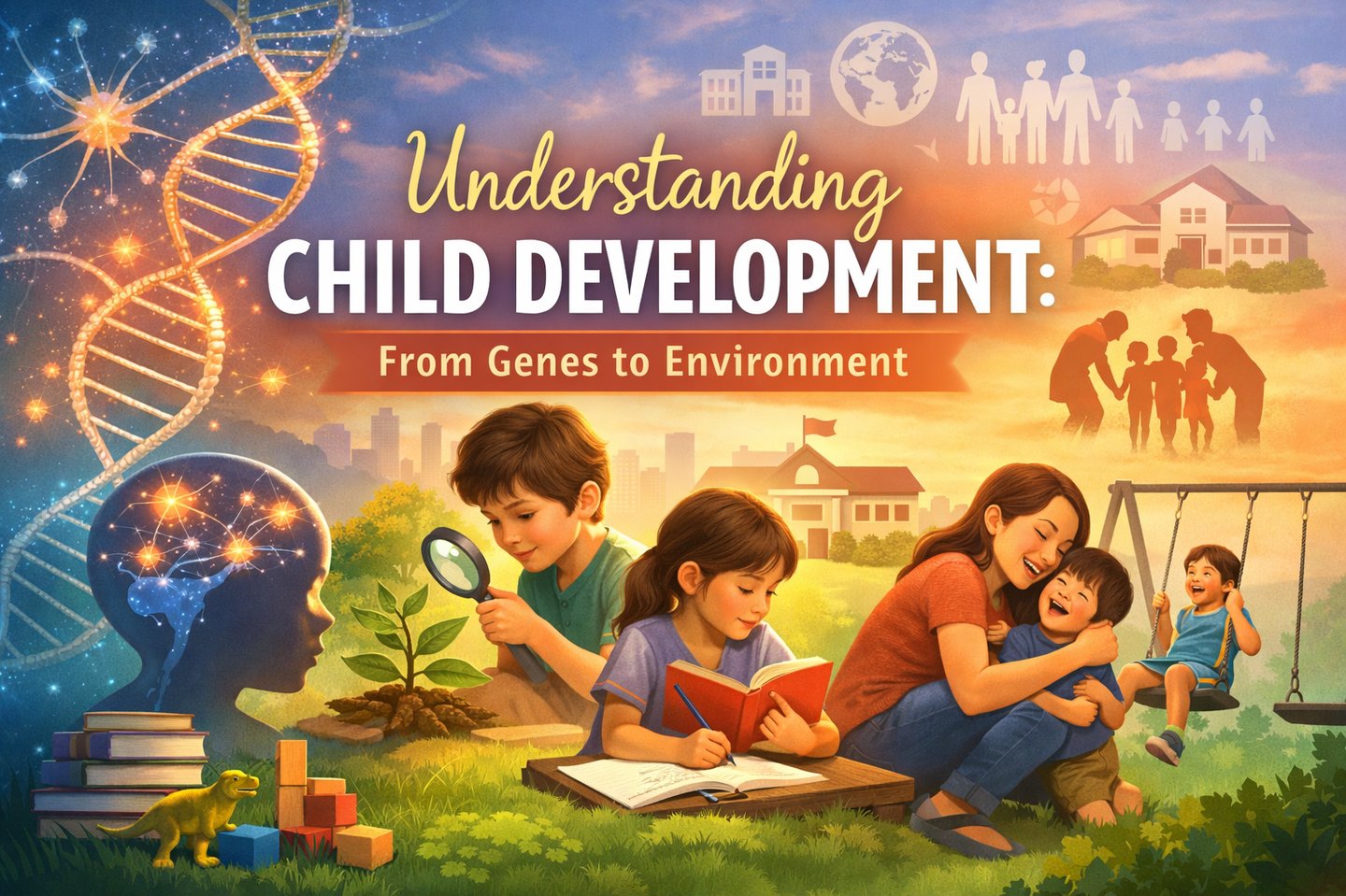
Child development is a dynamic process shaped by the continuous interaction of genetics, environment, and relationships. This blog helps parents understand how everyday experiences influence a child’s emotional, cognitive, and social growth. Discover practical, science-backed insights to nurture confident and happy children.
PARENTING
Astha Ungrish
4/14/20264 min read
Introduction to Child Development
Modern parenting extends beyond providing food, education, and discipline; it requires a deep understanding of how children grow, think, behave, and adapt. Child development is a dynamic process shaped by many interconnected factors over time. For those fostering nurturing environments, such as the Viha family, understanding these elements enhances the ability to guide, support, and empower children effectively.
This guide presents the science of child development in clear, practical terms, connecting theory with daily parenting. It shows how biology, environment, relationships, and time each contribute to shaping a child's future.
What Does “Child Development” Really Mean?
Child development is often misunderstood as just physical growth or academic progress. In reality, it is much broader.
Development encompasses systematic and continuous changes in a child’s physical, emotional, cognitive, and social abilities. While definitions vary, research agrees that development is a dynamic process shaped by multiple interacting factors, rather than a fixed path.
Different experts interpret development differently, but one thing is clear:
It is not linear, not predictable, and not the same for every child. Recognizing this helps parents shift expectations—focusing on observation rather than comparison.
Nature vs Nurture: The Biggest Parenting Myth
For decades, one of the biggest debates in psychology has been:
Is a child shaped more by genes (nature) or environment (nurture)? Contemporary developmental science recognizes that this debate is outdated. Current research confirms that nature and nurture are deeply interconnected, not separate forces.
A child’s genetic traits influence how they respond to their environment.
The environment, in turn, influences gene expression.
For example:
A naturally shy child may become confident with supportive parenting.
A highly active child may develop focus with structured routines.
This demonstrates that development is not predetermined by genetics; it can be shaped by intentional actions.
The Developmental Systems Approach: A New Way to Understand Growth
Modern psychology adopts the developmental systems approach.
This approach explains that:
Development happens through continuous interaction between biology and the environment.
Factors such as brain activity and social surroundings interact continuously.
There is no single path of development.
This is empowering for parents because it highlights that:
Interventions matter
Parenting style matters
In simple words:
Small daily actions can shape long-term outcomes.
The Bioecological Model: Understanding Your Child’s World
One of the most influential theories in child development was proposed by Urie Bronfenbrenner.
His bioecological model explains how a child’s development is influenced by different layers of environment.
Let’s break it down in simple parenting terms:
1. Microsystem: The Child’s Immediate World
This includes:
Parents
Siblings
Teachers
Friends
These are the people a child interacts with daily.
For example:
A warm, responsive parent-child relationship builds emotional security.
A supportive teacher builds confidence.
Important insight:
Children are not passive—they also influence how others behave with them.
2. Mesosystem: Connections Between Environments
This refers to how different parts of a child’s life interact.
For example:
When parents communicate with teachers
When home routines support school learning
A strong connection between home and school leads to better development.
Practical parenting tip:
Attend school meetings, understand your child’s classroom experience, and align home routines.
3. Exosystem: Indirect Influences
These are environments the child doesn’t directly interact with, but they still affect them.
Examples:
Parents’ workplace stress
Family financial conditions
Social support systems
If a parent is stressed at work, it can affect how they respond to the child at home.
Key takeaway:
Your well-being directly impacts your child—even if they don’t see the cause.
4. Macrosystem: Culture and Society
This includes:
Cultural values
Laws
Education systems
Parenting norms
For example:
Countries with strong parental leave policies support early bonding
Cultural beliefs influence discipline styles
In India, for instance, joint family systems can provide emotional support but may also bring conflicting parenting views.
5. Chronosystem: The Role of Time
Time changes everything.
This includes:
A child growing older
Family changes (like a new sibling)
Life events (moving cities, changing schools)
The same event can affect children differently depending on their age.
For example:
A new sibling may confuse a toddler
But excite an older child
Parenting insight:
Timing matters as much as action.
Inside the Child: How Biology and Behavior Interact
While the environment is important, development also happens inside the child.
Another influential theory by Gilbert Gottlieb beautifully explains this.
The Theory of Probabilistic Epigenesis
This theory says that development is shaped by four interconnected levels:
Genetic activity (genes)
Neural activity (brain)
Behavior
Environment
These are not one-way influences—they interact continuously.
What Does This Mean for Parents?
Genes do not directly control behavior.
Experiences can influence gene expression.
Learning changes brain structure.
Behavior shapes environment, and vice versa.
For example:
Talking to your child strengthens brain connections.
Encouraging curiosity builds learning pathways.
Stressful environments can affect emotional regulation.
This concept is also supported by epigenetic research, which shows that the environment can turn certain genes “on” or “off”.
Why Every Child Develops Differently
One of the most important lessons from developmental science is:
There is no single “correct” path of development.
Children grow in:
Different families
Different cultures
Different emotional environments
Even siblings raised in the same house can turn out very differently.
Why?
Because development depends on:
Individual temperament
Timing of experiences
Interactions across systems
This is why comparison is harmful.
The Role of Parents: Where You Truly Matter
Understanding development is not just theory—it has a real-life impact.
If development were fixed, parenting wouldn’t matter.
But research clearly shows it does.
Here’s where parents make the biggest difference:
1. Creating a Safe Emotional Environment
Children thrive when they feel:
Loved
Heard
Accepted
Emotional safety builds confidence and resilience.
2. Being Consistent, Not Perfect
Consistency in:
Rules
Routines
Responses
helps children feel secure.
Perfection is not required—predictability is.
3. Encouraging Interaction and Exploration
Development happens through interaction.
Talk, play, explore, and engage with your child daily.
Even simple activities like storytelling or pretend play can boost development.
4. Managing Your Own Stress
Parents often overlook this.
But emotional spillover is real.
Taking care of your mental health is one of the best things you can do for your child.
5. Adapting to Your Child’s Unique Needs
Every child is different.
Some need:
More structure
More emotional support
More independence
Observe, don’t assume.
Practical Parenting Insights from Developmental Science
Here are actionable takeaways every parent can apply:
Development is not fixed—it can be shaped.
Environment matters as much as genetics.
Relationships are the strongest influence.
Timing of experiences affects outcomes.
Small daily interactions create long-term impact.
The Bigger Picture: Why This Matters Today
In today’s fast-paced, digital world, children are exposed to:
Screens at an early age
Academic pressure
Reduced physical play
Changing family dynamics
Understanding development helps parents:
Make informed decisions
Reduce unnecessary pressure
Focus on holistic growth.
Final Thoughts: Raising Children with Awareness
Child development is not about creating “perfect” children.
It is about creating:
Emotionally secure individuals
Curious learners
Confident thinkers
The journey of parenting becomes easier when parents understand that:
They are part of a larger system.
Their actions matter deeply.
Growth is a continuous process.
Stay Connected with Viha’s Parenting Journey 💕
For more practical parenting tips, real-life experiences, and insights into child development, parents are encouraged to follow Viha’s journey on Instagram.
👉 Follow: Viha.official09
Contact:
hello@vihaofficial.com
All Rights Are Reserved!